|
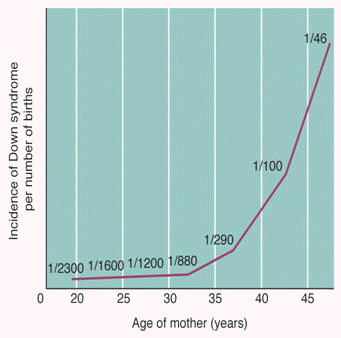
Prenatal DevelopmentDown SyndromeThe human genome consists of 46 homologous chromosomes: 23 chromosomes from each parent. Down syndrome (DS), also known as trisomy 21, is a prenatal genetic disorder caused by the presence of an extra chromosome 21. Unlike abnormalities caused by the exposure to teratogens, DS is related to maternal age; that is, the older the mother, the higher the risk of producing an egg with chromosomal abnormalities (Gelbert et al., 2002) (Figure 1).
Figure 1. The relationship between maternal age and the likelihood of giving birth to a Down syndrome child (Gelbert et al., 2002).
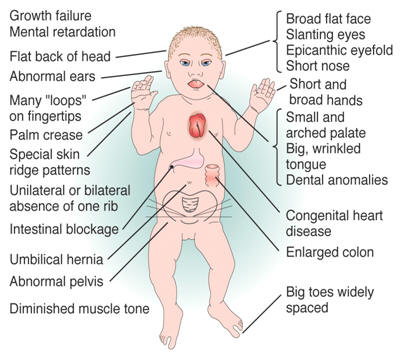
As Canada's population continues to increase, teachers are beginning to see a progressively larger number of students with genetic abnormalities in their classrooms. Because there is an overlap in some of the physical characteristics observed in various genetic defects, it is important for a teacher to accurately distinguish between the different genetic disorder types. People with DS possess short broad hands, short stature, and diminished muscle tone (Figure 2). Combined with these physical defects, DS students are mentally handicapped with an IQ in the 20 to 50 range (Gelbert et al., 2002). There are no particular behavioural patterns unique to people with DS, but they are likely to become frustrated or anxious more easily than normal people (Alton, 2000). Most of their behaviour depends on how they have been raised at home prior to schooling. Moreover, students with DS may experiences problems with their speech and language, auditory short-term memory, and motor coordination. They may also possess a shorter concentration span and take longer learning the rules of the classroom (Alton, 2000).
Figure 2. Characteristics of Down syndrome (Gelbert et al., 2002). Regardless of how old they become, these learning difficulties are prominent throughout their lifetime. Therefore, it is important for all teachers - whether it's preschool, K to 12, and even adult school teachers to understand their student's unique struggles and demands. Often, when a child with DS encounters difficulty coping with a certain class activity, they will begin to show inappropriate classroom behaviours, as they are naturally sensitive to failure (Johnson, 2004). An elementary school teacher who is aware of these circumstances can show greater recognition towards the student's failures and be more encouraging and caring to keep the student on task; the teacher must also avoid criticizing the child. Furthermore, a teacher can reassess the lesson plan to ensure it is suitably differentiated to fit the needs of all students; making sure it is not overexerting the DS student's cognitive potential. Many students with DS know far more than they can express in words (Johnson, 2004). A teacher teaching a student with DS must teach the student to communicate in whatever way works and teach the other students how to engage in the same manner when communicating together. For instance, if a student cannot formulate the correct words, a teacher can ask the student to use pictures, drawing, symbols, and signs to demonstrate their understanding. This is an important method to practice because it gets "inside" the student's head and effectively develops expressive skills (Johnson, 2004). Furthermore, some students with DS may experience difficulty processing information or multitasking, due to a lack of sensory or motor development. In this case, a knowledgeable teacher will try to sit the student in a quiet space where excess noise, light, and activity will not be distracting. It has been noted that people with DS have a weakened immune system and increased susceptibility to infection (Kolata, 1989). To prevent respiratory infections, for instance, a classroom must be free of pollutants, allergens, toxins, and chemicals. Although this is a difficult task to maintain, these factors should be kept to a minimum to promote growth of the students and to stimulate their overall development. In addition, if a DS student is taking medication, it is important for teachers to find out what it is, how it works, and when it is supposed to be taken, in case the student forgets. Overall, a teacher who knows about DS will better appreciate the capabilities of their students, be more supportive and caring towards their classroom needs, and in turn, influence a student's educational success.
|