|
|

Prenatal Development
A Brief Introduction to Prenatal Development
Prenatal development is one of the most significant segments of our development. It is an extraordinary process to learn and to acknowledge, as it emphasizes the many aspects most people tend to overlook. This information directly relates to our self-understanding, the mother who bore us, and the various joys and difficulties associated in the course of our nine month internal development.
The Effects of Teratogens on Prenatal Development
A human being developing in a mother's womb is an intricate process divided up into trimesters (three, three month periods). Throughout these nine months, prenatal development is constantly under strong influences, largely governed by genetics and external factors. If a baby's development were regulated mainly by their genetic composition, prenatal development would be more orderly and precise. External factors, on the other hand, influence pregnancy either positively or negatively. For instances, the amount of oxygen a fetus receives is an external factor that exerts an influence on the baby's growth, regardless of any genes the baby inherits. Providing appropriate levels of oxygen allows the fetus to reach its full genetic potential (Harding & Rees, 2004), which often determines how the child will behave, perform, and respond after birth and later on in school.
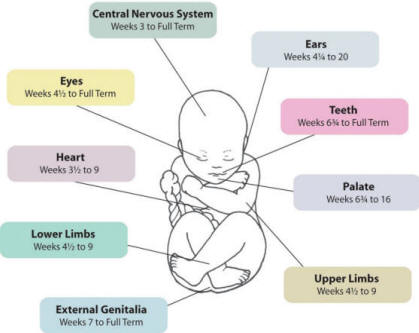
Figure 1. Periods of Fetal Development.
There are many external factors that negatively impact both the fetus and the mother during pregnancy; some of which cause permanent prenatal abnormalities. These broad range of substances, known as teratogens, are readily found in almost any environment. Teratogens can be airborne contaminants, such as harmful gases, vapours, and pesticides; drugs and medication, such as cocaine, anticonvulsants, and Thalidomide; congenital infections, such as human immunodeficiency virus and syphilis (Table 1); consumption of alcohol; cigarette smoking, radiation, and stress. With the availability of new tools such as 3-dimensional ultrasound and magnetic resonance imaging, it has been shown that the critical period of organ and limb development occurs within the first trimester - more specifically, the first eight weeks of growth (Citen & Giorgio, 2006; Figure 1). Women who are exposed to high doses or high levels of teratogens during this sensitive stage in prenatal development can increase the risk of causing various mental and physical complications in the baby; in most cases, these conditions are irreversible. Figure 2 offers a startling example of apparent neurological effects of pesticide poisoning on children caused by high levels of exposure during pregnancy.
Table 1. A List of teratogens and their effects on human health.
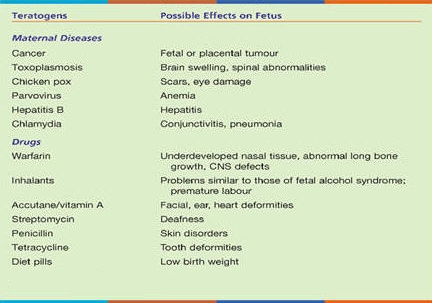
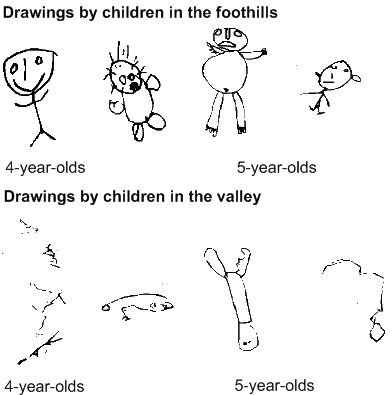
Figure 3. Elizabeth Guillette, an anthropologist, was interested in the effects of pesticides on children. She chose a study site in Yaqui Valley region in Mexico. When synthetic pesticides arrived in the area in the 1940's, some Yaqui farmers embraced the use of pesticides for agriculture, while others continued to follow more traditional farming practices in the foothills area. Although differing in farming techniques, the population shared the same culture, diet, education system, income levels, and family structures. When asked to draw people, young children from the foothills where pesticides were not used drew recognizable figures, while children from the valley where pesticides were heavily used could draw only scribbles. Adapted from (Guillette et al., 1998).
A teacher can usually identify a normal student from a student with physical abnormalities. For instance, students who have fetal alcohol syndrome (FAS) have similar facial features, such as a small non-symmetrical head, short nose, widely spaced eyes, thin upper lip, and small ears (Figure 4). In addition to these physical characteristics, a teacher can also identify a child with FAS, or its milder form fetal alcohol effects (FAE), by noticing learning disabilities, attention or memory deficits, inability to manage anger, poor judgment, or difficulties solving problems. FAS occurs when a mother overly consumes alcohol during pregnancy. When alcohol (a teratogen) crosses the placenta, it cannot be removed by the liver since the liver of an embryo is not fully developed until the last trimester; consequently, it depresses the function of the fetuses nervous system (Campbell & Farrell, 2006). A teacher who is aware of the normal responses associated with FAS/E students will approach the child in a different manner and accurately interpret their classroom behaviour, rather than responding in a way that may create a more difficult situation. For instance, if an FAS student repeatedly makes the same mistake of forgetting to complete his/her homework, a knowledgeable teacher would take the initiative in making a personalized checklist that the student can take home, as opposed to getting angry and punishing the student unjustly. Knowledge about teratogens can help the educator recognize that it is not the student's main intent to purposely forget or misinterpreting the situation and blaming laziness or poor parenting. Moreover, to improve a FAS/E student's poor judgment and social skills in the classroom, a teacher can include the student as often as possible, or have them work on activities that encourage decision making by giving the student choices and allowing the student to carry through with the choices they make (Teaching Students with FAS, 2006). To improve memory skills, a teacher can modify their lessons to include many examples, making it easier for the student to learn and retain the concept.

Figure 3. An ad depicting the harmful effects of alcohol on prenatal development.
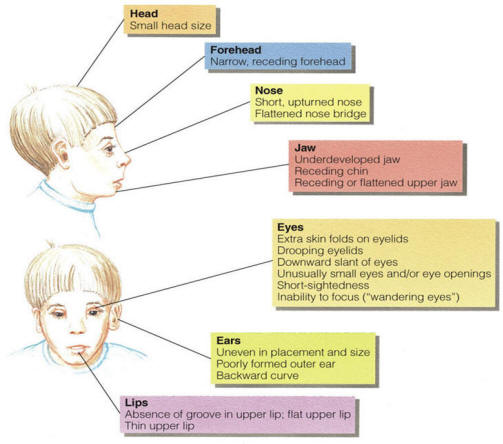
Figure 4. Physical characteristics of a child affected with fetal alcohol syndrome.
Some abnormalities caused by a teratogen may be difficult to detect at a young age. For instance, maternal diseases like syphilis or the use of streptomycin (a teratogen) during pregnancy can cause various degrees of deafness in a child (Biller et al., 2006). Deafness is not a physical defect that is readily detected by visual inspection. In the classroom, a student's inability to hear the teacher can become a communication barrier; this, however, should not mean that student cannot successfully participate in the regular school program. A teacher who encourages interaction between students who have hearing imparities with classmates who can hear normally, promotes a social and interactive setting. In order to ensure a learner-friendly classroom, a teacher may also modify the physical environment by eliminating any unnecessary distractions causing loud noises, such a fan or air-condition; this will help to improve concentration during class. Above all, by acknowledging the effects of teratogens on prenatal development, a teacher will have a better understanding of their student's learning abilities, weaknesses, and their parents' perception, and in turn, help to keep the classroom environment learner-friendly.
|
|