|
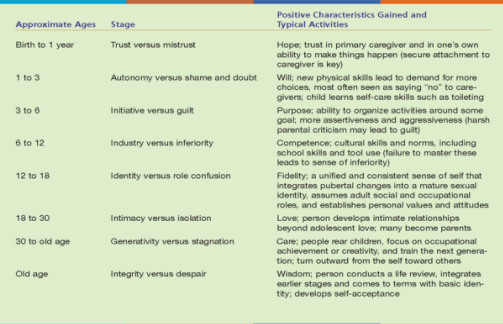
Personality DevelopmentErik H. Erikson's StagesThere has always been a link between the way societal pressures and cultural influences affects one's personality. Erik H. Erikson, a 20th century development psychologist, explored many of these relations and identified eight psychosocial character-forming stages of human development that sequentially unfold in a person's lifetime as they grow and mature (Auger & Rich, 2007) (Table 1). Each one of Erikson's stages is characterized by a specific challenge or a unique developmental crisis typically encountered by a person of its specified age group. Each developmental task or crisis must be resolved before moving on to the next stage. When a crisis is resolved successfully, "[it] forms a solid foundation for personality growth and healthy emotional development" (Auger & Rich, 2007, p. 29). Organizing one's psychosocial development in this manner implies that this principle is genetically inevitable in shaping anyone's human development, regardless of their culture or ethnicity.
Table 1. A chart displaying Erikson's eight psychosocial stages of human development.
Although only three of the eight stages (learning initiatives versus guilt; learning industry versus inferiority; learning identity versus identity confusion) take place during primary and secondary school, unresolved dilemmas prior to these stages can be revisited from earlier years if the student is provided with "on-going opportunities to practice making appropriate choices" in a learner-friendly classroom (Auger & Rich, 2007, p. 85). For example, if a child became severely ill in the first three years of their life, the child might not have had a chance to normally resolve the first and second psychosocial stages, namely: trust versus mistrust and/or autonomy versus shame and doubt. A teacher who acknowledges Erikson's stages and emphasizes decision-making in the classroom, even from an early age, helps students recuperate from unresolved crises that have led to undesirable affects, by allowing them to be more productive and adept at solving problems to which Erikson referred, using healthy resolutions (Auger & Rich, 2007).
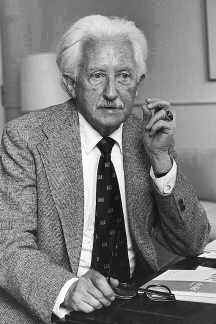
Figure 1. A photo of Erik H. Erikson. Most students begin their schooling career at the learning stage versus the guilt stage, either in preschool or in kindergarten. As an educator, it is important to gear the student towards a positive learning experience rather than one of guilt. A positive learning experience at this stage is characterized by a healthy attitude of being able to initiate actions independently. Teacher who introduces their students to various classroom activities to which the students can initiate and perform on their own will help them overcome feelings of powerlessness and guilt about being dominated by the environment (Auger & Rich, 2007). For instance, a teacher could assign every every student a classroom role that will enable them to collaboratively participate in tidying up the classroom at the end of the day. Opportunities like these helps build a sense of confidence and responsibility; on the contrary, harsh teacher criticism may lead to guilt and feelings of anxiety. The next stage, learning industry versus inferiority, involves the developmental task of acquiring a sense of competence while avoiding inferiority. This stage occurs in middle and late childhood, ages six years to the start of puberty, during elementary school. Students facing this crisis will often evaluate their accomplishments by comparing self with others, especially as they are drawn into social culture of peers (Auger & Rich, 2007). As they gradually develop intellectual and physical skills, they want to see how productive and competent they are with these new abilities. It is crucial for teachers to stimulate this need for productiveness by having students do more productive work on their own. During this stage, students want to be recognized and rewarded though the things they do in the classroom. Therefore, teachers should constantly encourage their students to succeed. If their attempts to succeed fail, and the teacher provides little feedback or negative feedback, the student will end up feeling incompetent, and in turn, feel inferior. The final stage before the transition from adolescence to adulthood is learning identity versus identity confusion. During this time in a person's life, one develops a stable personal identity and establishes a clear path toward a vocation (Auger & Rich, 2007), asking questions like, "who am I?" Or "what will become of me?" It is important for teachers to support students during this critical time of decision making. For instance, educators should constantly focus in on the effects of peer pressure by teaching students how to make the appropriate decisions and choices. This builds confidence in a child and prevents confusion when confronted with peer pressure. If a child feels like he/she is being called to a certain profession, teachers should provide resources and personal advice pertaining to the profession. This way students can adequately explore and identify a positive future path. Solutions to each crisis do not have to be completely positive in nature, as some aspects of negativity are inevitable. As long as positive resolutions dominate, a positive outlook will result at the end (Auger & Rich, 2007).
|