|
Brain DevelopmentTopics
Left Hemisphere Versus Right HemisphereA child's early brain development depends on many factors. The three most predominant factors are nature (genetics), the environment, and personal experience. Genetics play a major role in determining the number of neurons needed for proper function, and the way they are to be organized in the brain, before and after birth (Jabs, 1996). A safe and secure environment also paves the way for proper development of the brain as it reduces stress and anxiety - both of which are capable of destroying brain cells. In most children, however, personal experience proves to be the main cofactor responsible for proper brain development and stimulation. Like protein, fat, and vitamins, interacting with other people and objects are vital nutrients for the growing and developing brain, and different experiences can cause the brain to develop in different ways (Hawley, 2000). Unlike the other two factors mentioned, personal experience is sometimes considered a control mechanism for gene activity; that is, specific experiences regulate particular genes that are expressed. If the child has experienced abuse or neglect early in their life, a genetically normal child can become mentally ill or experience irreversible behavioural problems, which is often recognized at school (Hawley, 2000).
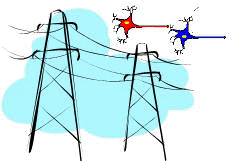
Figure 1. Neurons are like growing telephone wires that communicate with one another (left). A student's ability to understand language, solve problems, and get along with other peers at school will be influenced by their experiences as an infant and a young child. Like growing telephone wires that communicate with on another (Gopnik et al., 1999), neurons make up the wiring of the brain. Neurons allow separate areas of the brain to communicate with one another by making new synapses with neighbouring neurons (Figure 1). As the brain develops throughout childhood, neurons that have not synapsed are eliminated by a process called pruning (Auger & Rich, 2007). The lack of experience during childhood can cause over-pruning, leaving the child struggling to what would have come more naturally (Hawley, 2000). To compensate for any potential loses, brain cells undergoes neuroplasticity - a lifelong ability of the brain to reorganize pathways based on new experiences (Auger & Rich, 2007). This process aids the process of learning and memory. Without this physiological ability, no one would be able to form a new memory, recover from a brain injury, master a new skill, or adjust to a new environment (Hawley, 2000).
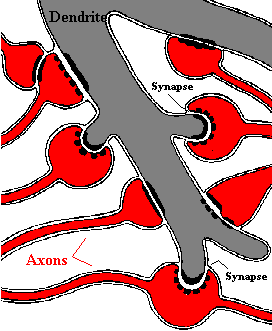
Figure 2. Multiple axons terminals synapsing on a neighbouring neuron. In order for a teacher to promote and assist students in the development of these skills, they must have a good understanding of the types of activities that will help stimulate these areas of physical growth. For instance, an elementary school teacher may want to include simple activities like painting with different types of brushes, alternating between large, stubby brushes and smaller, finer brushes (Versluys, 2002). This will allow the students to be more precise in their work and to develop a better grip, which is needed for more defined writing. Students who are just starting to learning how to print may experience frustration using a regular pencil. To help the student develop the fine motor skills needed to use a regular pencil, a teacher can assist the child by providing a primary-size pencil. This will help improve their writing, and in turn, assist their self-esteem by providing a sense of accomplishment. Likewise, if a high student feels uncomfortable writing an answer to a question on board because they feel their hand writing is messy, a teacher should also provide the option to have their students respond verbally instead. For younger students, such as preschoolers and kindergarteners, a teacher may encourage students to play with material that is more manipulative, such putting together pieces of a puzzle or molding a sculpture out of play-dough (Versluys, 2002). This will allow them to better develop hand-eye coordination and gain better control over their finger movement. To teach gross motor skills, elementary school teachers can plan their physical education lessons to include activities with greater muscle movement, such as running, dancing, and team sports that promote balance and coordination. High school science teachers can also encourage gross motor development by taking their students out on nature walks. Overall, knowing about these skills will help an educator better understand where there students are coming from, suspect any delays students may be experiencing, and better prepare for lesson plans by adding more time for physical activities. As an educator, it is very important to introduce the child to new experiences everyday, rather than having them do repetitious activities that cannot further stimulate their minds. A kindergarten teacher knowledgeable about neuroplasticity and the need for experience will incorporate many toys, posters, and activities in the classroom to spark a child's flowering imagination. If a student has not received enough exposure to language in early childhood or in past grades, knowing that the brain can make new connections encourages teachers not to lose hope in a student's learning capabilities. A teacher can provide the student with opportunities to bounce back from negative experiences by specifically targeting the area that was not nurtured in the early years. For instance, to stimulate their language and reading, teachers can put students who are in need of this skill to take part in a special program that focuses mainly on language and communication, as it may jumpstart specific regions of the brain. Activities such as daily exercise, listening to music during class that contains rhythm, rhyme, and repetition, or having the students do art, cause different areas of the brain to grow new neural connections, develop stronger connections or become more active. Any teacher who introduces their students to frequent new learning experiences and challenges is providing all the necessary "nutrients" needed to enhance and stimulate their brain growth (Brotherson, 2007).
|